Cat trust guide
How to Get a Cat to Trust You
Trust grows when a cat has choices: where to sit, how close to be, and whether to interact. Start by making your presence predictable and let your cat show you what feels manageable today.

What trust looks like in a cat
Trust is not always a cat climbing into your lap. It can begin much smaller: eating while you are in the room, watching you with a softer body, playing nearby, or choosing not to leave when you stand up. Those choices matter because they show that your presence is becoming less costly.
Try not to measure progress against a particular personality. Some cats become social quickly; others prefer a quiet relationship with more space. The useful question is whether your cat has more comfort and more choice than before.
1. Give your cat control over distance
Start at the distance where your cat can notice you without tensing, fleeing, or freezing. Sit sideways rather than facing them directly, move slowly, and avoid reaching into their hiding place. If they back away, return to the previous comfortable distance. That response is useful information about what they can handle today.
If your cat retreats before you get close, our guide to why cats run away from people can help you make the approach smaller and easier.
2. Build a predictable routine
Reliable meal times, a calm voice, and similar movements help a wary cat learn what happens next. You do not need to entertain your cat constantly. A few short, quiet moments each day are often more useful than one intense socialization session.
For a recently adopted cat, hiding can be part of that early adjustment. Learn what to do when a new cat keeps hiding before trying to draw them out.
3. Become associated with good things
Pair your presence with things your cat already values: a meal placed at a comfortable distance, a tossed treat, a favorite resting spot left undisturbed, or a low-pressure play session. Good things should arrive without a demand for touch or eye contact.
Food is feedback, not leverage. If your cat cannot eat while you are nearby, increase distance and let the situation feel easier before trying again.
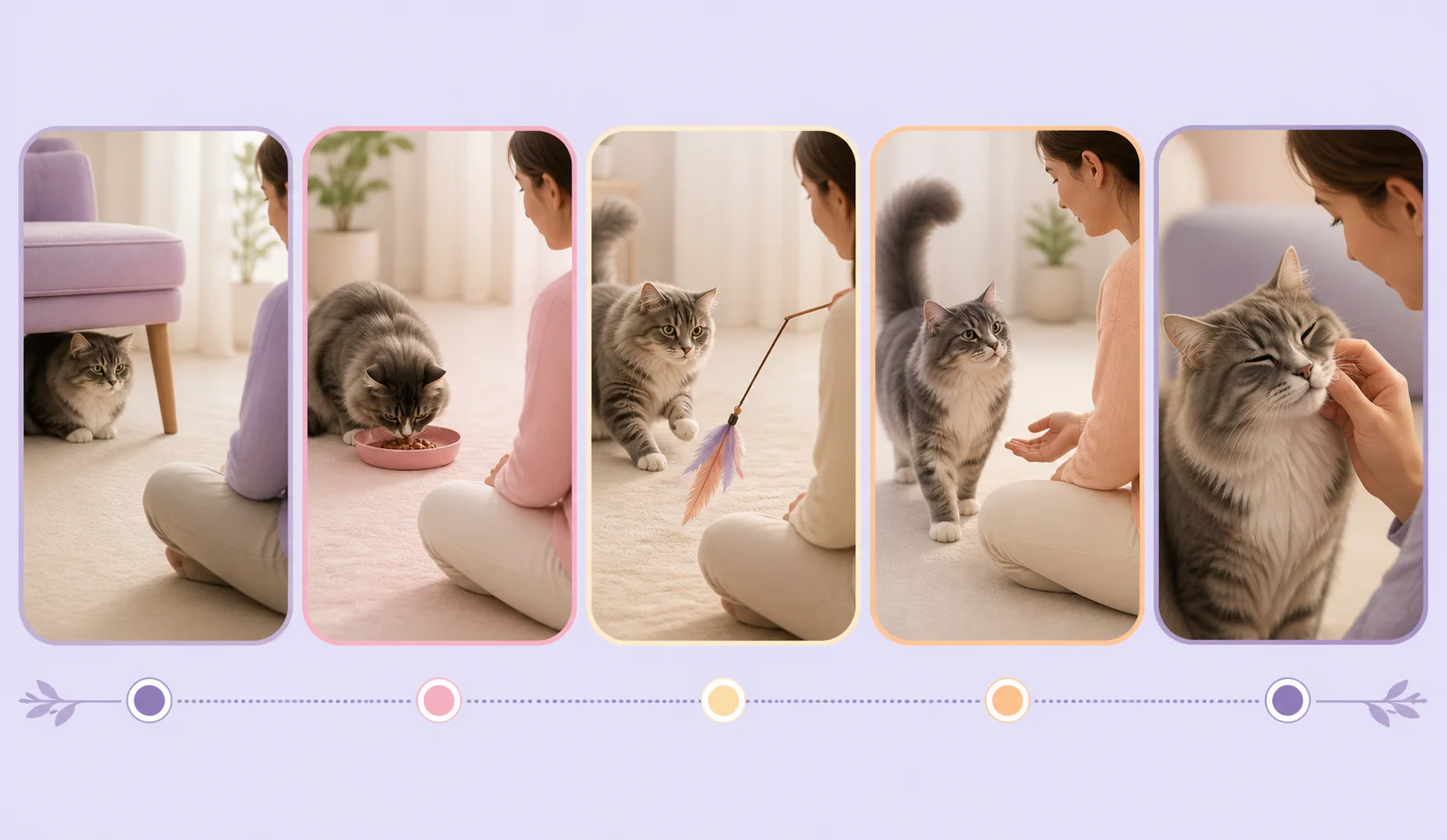
- Comfortable distance
- Eat nearby
- Play together
- Choose to approach
- Brief touch
4. Use play as low-pressure interaction
A wand toy lets a cat participate while keeping space. Move the toy away from them rather than toward their face, and pause often enough that they can decide whether to continue. Play is not a test; it is a shared activity that your cat can leave at any time.
Once your cat is staying nearby, it is reasonable to shorten distance in very small increments. This is one part of how cat socialization works more broadly.
5. Let your cat initiate more interactions
When a cat begins to approach, keep your response modest. Offer a low, still hand and let them investigate. Do not turn a first approach into a pickup or a long petting session. Ending an interaction while it still feels easy teaches your cat that closeness does not cost them control.
Introduce touch only after repeated voluntary proximity and relaxed body language. A brief cheek or shoulder touch may be enough at first; then stop and see whether your cat stays or returns.
What can damage trust
Chasing, cornering, pulling a cat from hiding, staring, reaching from above, and forcing restraint can all make the next interaction harder. Even well-intended handling can be too much when a cat is already afraid. If fear seems directed toward you, see why your cat may be scared of you for a gentler reset.
How long does it take for a cat to trust you?
There is no reliable deadline. History, health, temperament, the home environment, and how much choice your cat has all shape the pace. Notice small milestones instead: a normal appetite while you sit nearby, a longer look without retreating, a play session, or an approach they chose themselves.
What if your cat was feral or poorly socialized?
Some cats need a more structured beginning because people themselves are still unfamiliar. Begin with safety and predictable presence rather than touch. For a kitten with little human experience, use our dedicated guide on how to socialize a feral kitten.
When behavior could have a medical cause
Sudden withdrawal, pain when touched, reduced appetite, or a sharp behavior change deserves veterinary attention. A veterinarian can rule out medical contributors, while a qualified feline behavior professional can help with a tailored plan. Mewntor is educational support, not veterinary diagnosis or emergency care.
Frequently asked questions
How do I make a cat like me?
Focus on safety and choice instead of trying to win affection quickly. Predictable routines, respectful distance, and voluntary play are more useful than forced closeness.
Should I pick up a scared cat to help them get used to me?
Usually no. Restraint can teach a fearful cat that approach means loss of control. Let touch and handling follow repeated signs of comfort.
Can a shy adult cat learn to trust people?
Yes, many do. Their preferred relationship may include more distance than another cat's, but patient, consistent experiences can make that relationship feel much safer.