Trust timeline guide
How Long Does It Take a Cat to Trust You? The 3-3-3 Rule
There is no fixed deadline, but there is a shape. Most cats move through the same three stages when they learn to trust a person, and each stage has signals you can notice. Knowing where your cat is in it tells you what to do today.
The short answer: the 3-3-3 rule
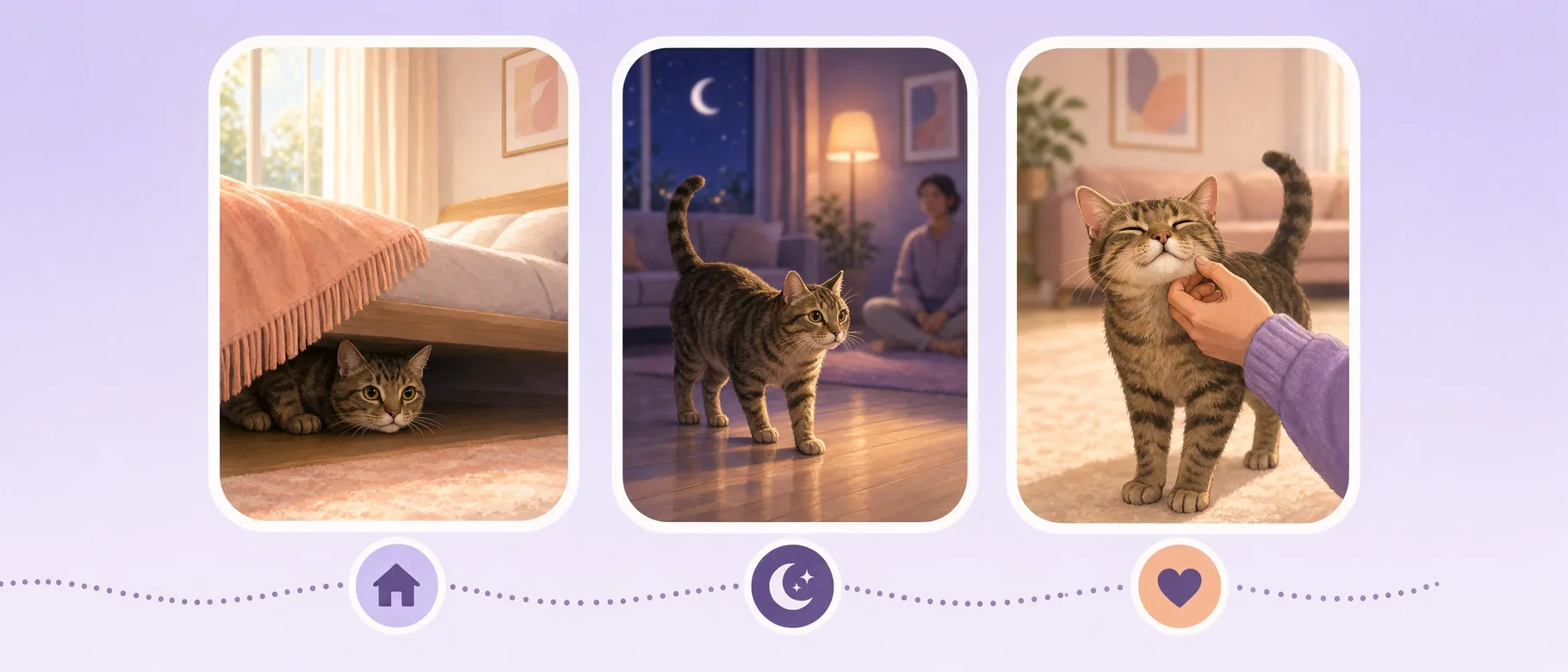
Shelters and adoption organizations, including Pasadena Humane and Austin Pets Alive!, describe a new cat’s adjustment as the 3-3-3 rule: about 3 days to decompress, about 3 weeks to settle into a routine, and about 3 months to feel at home. The same shape applies to any cat learning to trust a specific person, not only newly adopted ones.
Those numbers are a guide, not a promise. Some cats move faster; shy cats, older cats, and cats with difficult histories need the full range or longer. What makes the stages useful is that each one comes with observable signs, so you can tell where your cat actually is instead of guessing from the calendar.
Stage one: the first three days
A cat in this stage is overwhelmed, not rejecting you. Pasadena Humane describes what that looks like: not eating or drinking normally, missing the litter box or going in their hiding place, yowling, shutting down under furniture, and avoiding play. The physical signs are easy to miss because they are small: dilated pupils, ears back, whiskers pulled in, a tucked tail.
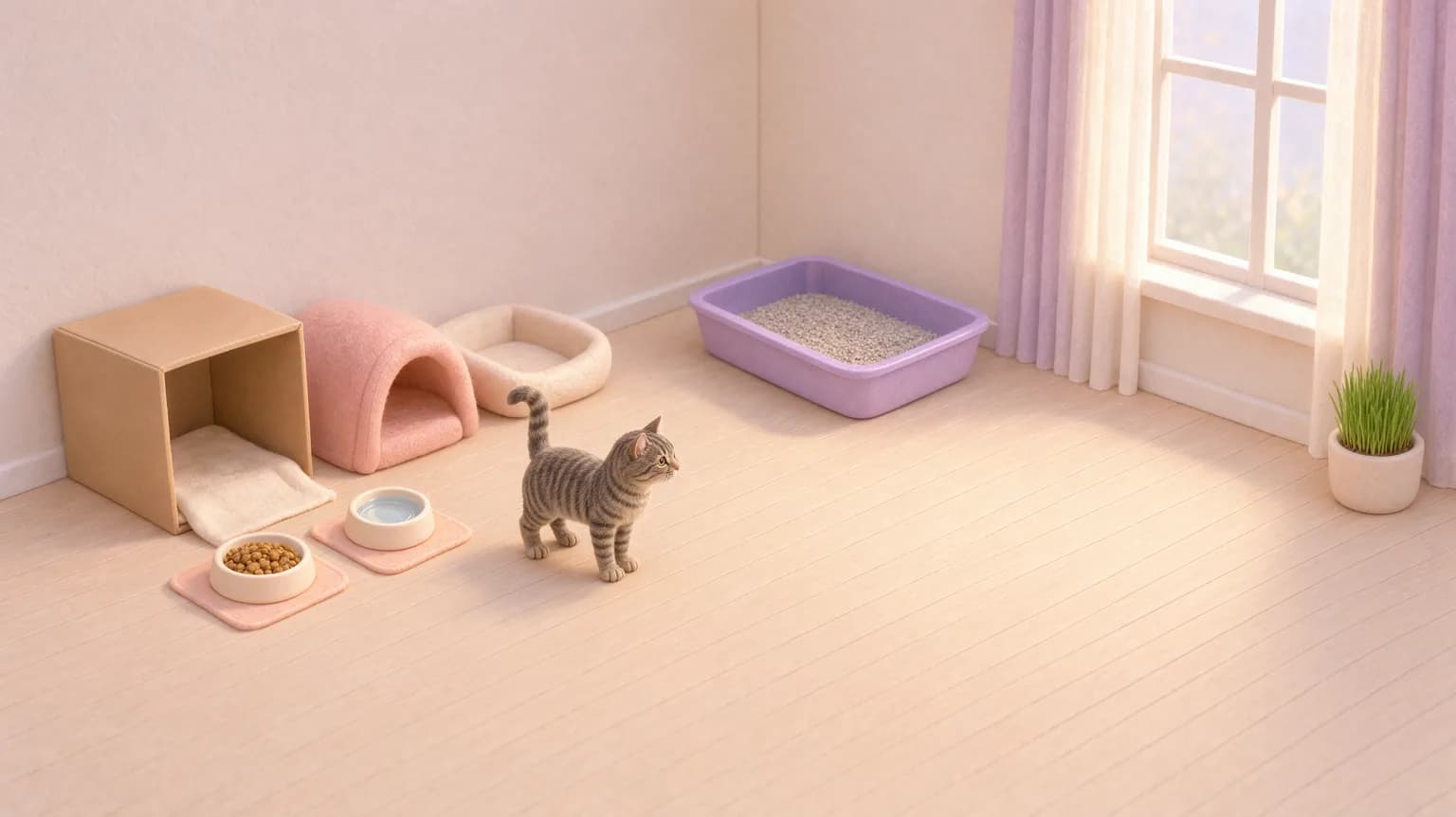
The right move in stage one is almost always to do less. One quiet room, with food, water, and a litter box in predictable places, and a refuge the cat can retreat into with a clear exit. Your presence in the room should be low and still: working quietly at a distance teaches more than trying to interact.
Stage two: roughly three weeks
By around week three, most cats respond to routine cues: they expect meals, they come out of hiding more, and adult cats usually use the litter box consistently. Stress signals reduce, even if your cat still avoids play or contact. Nighttime exploring is common at this stage and is worth treating as progress, not a problem.
This is also the stage where small experiments work: a wand toy moved away rather than toward your cat, a treat offered at a distance, sitting sideways at the edge of their comfortable zone. If your cat startles and retreats, the ask was one step too big; make it smaller next time. Three weeks of easy interactions beats one ambitious one.
Stage three: around three months
By roughly three months, a settling cat shows what Pasadena Humane calls natural behaviors: scratching normally, purring, kneading, stretching slowly, walking around with a loose body, and taking treats gently. House-soiling problems, if there were any, usually resolve alongside this. Your cat initiates more: following you room to room, sleeping in the same space, greeting you at the door.
A cat at this stage still has limits, and respecting them is what keeps the trust stable. The goal was never a cat who tolerates being picked up; it is a cat who chooses to be near you, which is what actually happened over the past months.
Why your cat may need longer than the guide says
The timeline compresses or stretches depending on a few honest factors:
- Age and history. A kitten socialized early turns around quickly. An adult with a long history of avoiding people may settle into a relationship with more distance, and that can still be a good one.
- Stray or feral. A stray cat has been socialized once and can usually come back. A truly feral adult was never socialized and rarely lives comfortably indoors. Our feral-kitten guide explains where that line sits and why age decides it.
- Health. Pain and illness change behavior before they look like illness. A sudden change in an adult cat deserves a veterinary check, not more patience.
- The home itself. Other cats, dogs, young children, or loud routines make adjustment longer. San Francisco SPCA’s advice is to shrink the world first: start in one calm room and expand gradually.
- Your own pattern. If approach has historically ended in pickup or restraint, your cat leaves early with you and not with others. That is learnable, but it starts at a bigger distance than feels necessary.
How to tell trust is actually growing
Measure the trend, not the calendar. Across all three stages, the same signals mark progress: your cat eats comfortably while you are in the room, recovers faster after a sudden sound, plays more, watches you with a loose body instead of freezing, and starts to close the distance themselves. A longer look without retreating counts. An approach you did not invite counts double.

Progress also pauses and resumes. A cat who was confident yesterday and cautious today is not back to zero; use the calmer setup for a day or two and move on. The trust-building steps work at every stage; the timeline tells you how big to make each step.
What if your cat trusted you and stopped?
Trust can slip after a vet visit, a move, a shouting match, or an unfamiliar smell, and it usually returns faster than it took to build. Go back one step: the distance and routine that felt easy before the setback, held for a few days, then reopened slowly. A cat who hid from you after a trip home is typically re-settling in days once the routine and your usual scent return. If avoidance of you continues for weeks, our guide to why a cat may be scared of one person covers what to change.
When to get help before waiting it out
Two clear points turn patience into a vet visit. Richmond SPCA’s guidance is that a new cat who has eaten nothing at all by the end of the second day needs a call to the veterinarian. Later, if your cat is still very withdrawn at around three weeks, the recommendation from adoption organizations is the same: involve a veterinarian, and a qualified feline behavior professional once medical causes are ruled out.
Any sudden change in a cat who was previously comfortable belongs in the same category: less grooming, hesitation when jumping, new hiding places, or a reduced appetite are how discomfort usually shows up first. Mewntor is educational support, not veterinary diagnosis or emergency care.
Where to go next
If your cat is in the first days at home, start with setting up a refuge that helps. If they already live with you but keep their distance, the step-by-step method is in how to get a cat to trust you, and the wider process is in our cat socialization guide.
Frequently asked questions
What is the 3-3-3 rule for cats?
The 3-3-3 rule is a shorthand shelters use for a new cat’s adjustment: about three days to decompress, three weeks to settle into a routine, and three months to feel at home. It describes a shape, not a deadline, and cats with difficult histories often need longer.
How long does it take a kitten to trust you?
Kittens usually warm up faster than adult cats, often within days to a couple of weeks when food and calm presence are consistent. A kitten with little human contact yet needs a more structured plan: see our feral-kitten socialization guide for what age makes possible.
How long does it take a shy cat to trust you?
A shy cat sets the pace, and the honest answer is weeks to months rather than days. What you can control is whether every interaction stays easy: shorter approaches, predictable routines, and no forced contact make a shy cat’s timeline shorter than extra effort would.
How long does it take a rescue cat to feel at home?
Shelters commonly describe adjustment in three stages: roughly three days to decompress, three weeks to settle into a routine, and three months to feel at home. Treat that as a guide, not a deadline; rescue cats with difficult histories often need the full range or more.
Can a feral cat ever learn to trust people?
A stray cat, once socialized and then separated from people, can usually come back into a home. A truly feral adult cat was never socialized and is unlikely to live comfortably indoors at any age. Young feral kittens are the exception with time-sensitive handling; the dedicated guide explains the difference.
How long does it take for a cat to trust you again?
After a setback, trust usually returns in days to a few weeks once the trigger settles. The reset is short: go back one step to the distance and routine that felt easy before, and rebuild from there rather than explaining or pushing.
My new cat has been hiding for two weeks. Is that normal?
It can be, as long as your cat is eating, using the litter box, and showing small signs of settling, like coming out when the house is quiet. If your cat is still very withdrawn after about three weeks, or stops eating at any point, involve a veterinarian; at that stage professionals recommend a check rather than waiting longer.
Can I speed things up by trying harder?
Trying harder usually slows trust down. Approaching more, holding a cat, or reaching into a hiding place teaches your cat that closeness costs them control. The fastest method is the quiet one: predictable care, food at a comfortable distance, and letting your cat close the gap.
Sources
This guide was written against published guidance from veterinary and feline-welfare organisations. Where a specific number or recommendation appears above, it is drawn from one of these.
- Pasadena Humane. The 3-3-3 Rule of Adopting a Cat.
- Pasadena Humane. Building Your Cat’s Confidence.
- Austin Pets Alive!. Helping Pets Adjust to New Homes: the 3-3-3 Rule.
- Richmond SPCA. Adjusting a Cat to a New Home.
- San Francisco SPCA. Hiding Behavior (Cats).
- International Cat Care. Stress in cats.